


Hyaluronic acid fillers have one important advantage over most other injectables: they can be dissolved. The tool for this is hyaluronidase, an enzyme that breaks down hyaluronic acid. Every clinic that works with HA fillers should keep it in stock, both for planned corrections and for urgent situations. This guide explains what hyaluronidase does, when it is used and what to look at when you buy it.
What hyaluronidase is
Hyaluronidase is an enzyme that splits the chains of hyaluronic acid into smaller fragments that the body then clears. It works on the cross-linked HA in dermal fillers and also on the body’s own hyaluronic acid, which recovers on its own over time. Medical hyaluronidase is usually supplied as a lyophilised powder in vials that the practitioner reconstitutes with sterile saline or water for injection right before use. Activity is measured in international units (IU).
When practitioners use it
- Correction of unwanted results: overfilled lips, lumps, asymmetry or filler that has moved from the treated area.
- The Tyndall effect: a bluish tint when filler sits too superficially, often under the eyes.
- Nodules and delayed swelling related to HA filler, after the cause has been assessed.
- Vascular complications: suspected intravascular injection of HA filler is treated as an emergency, and hyaluronidase is part of the published emergency protocols. This is the main reason clinics keep it on hand at all times.
- Before re-treatment: dissolving old filler before a new correction, when the previous product is unknown or has spread.
Hyaluronidase only works on hyaluronic acid. It has no effect on fillers based on calcium hydroxylapatite, polylactic acid or polycaprolactone, so it is important to know which product was injected.
What to check before treatment
The decision, the dose and the technique belong to the practitioner and should follow the product’s instructions for use and current clinical guidelines. In practice, clinics usually consider the following points:
- Allergy history. Hyaluronidase products are proteins, and allergic reactions are possible. Many practitioners ask about allergies, including to bee or wasp stings, and some perform a skin test before elective treatment.
- Type of filler and how long ago it was injected. Different HA fillers differ in cross-linking and may need different amounts of enzyme.
- Expectations. The enzyme can also reduce the patient’s own hyaluronic acid in the area for a while, so the result may look flatter at first.
How it is supplied
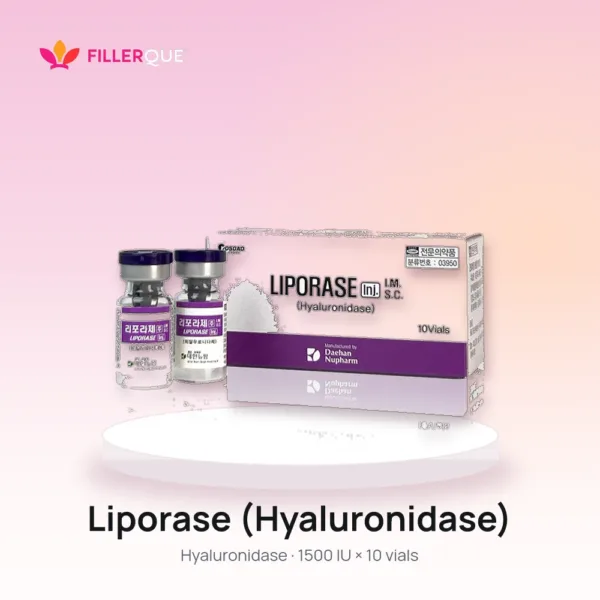
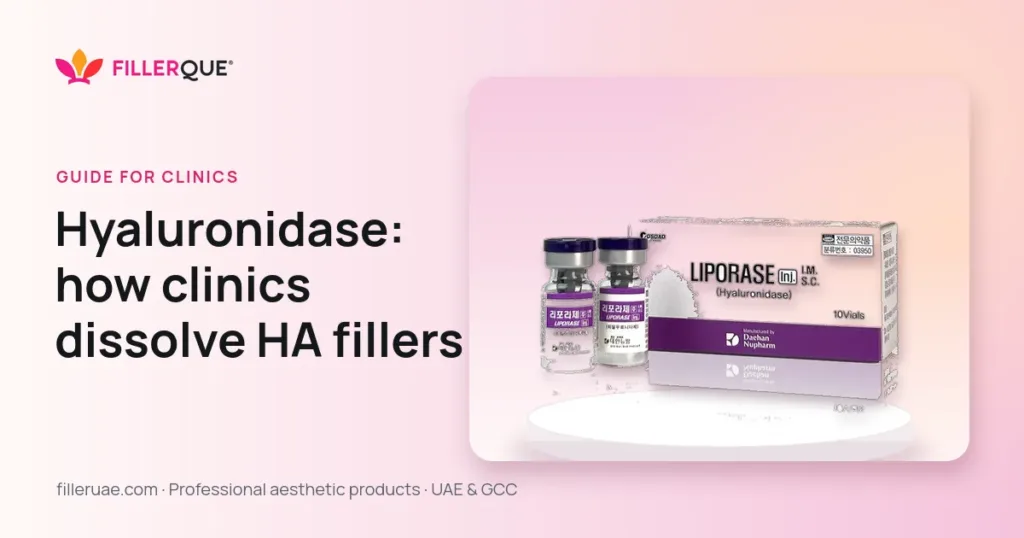
In our catalogue, hyaluronidase is represented by Liporase: lyophilised hyaluronidase 1500 IU per vial, 10 vials per box. The powder is reconstituted before use according to the manufacturer’s instructions. See the product page for the full composition and storage conditions.
Storage and stock
Store unopened vials as stated on the package and check expiry dates regularly — an emergency is the worst moment to discover that the only box in the clinic has expired. Reconstituted solution is usually meant to be used promptly, so follow the instructions for how long it can be kept. Clinics that use HA fillers every day often keep at least one full box in stock and reorder before it runs out.
Where to buy in the UAE
Hyaluronidase is in the Hyaluronidase category of our catalogue, next to dermal fillers and body fillers. Prices are in AED, orders are confirmed within 1 business day and shipped insured — see Delivery & payment.
This article is for healthcare professionals and is not medical advice. Hyaluronidase must be used by qualified practitioners according to the manufacturer’s instructions.